
Cupps' Cabinet: Introducing the Calculated Upside Player Prospecting System For Fantasy Football 2026
Alex Cupps debuts his first Cupps' Cabinet, where he introduces his Calculated Upside Player Prospecting System, aka the CUPPS model.
What’s up, guys! Welcome to the first-ever edition of “Cupps’ Cabinet”—my signature, recurring piece on Fantasy Life. This weekly article is going to be my main creative outlet over the coming months, where I talk about any and all things in the fantasy football landscape that intrigue me, confuse me or get me riled up to the point where I simply HAVE to talk about them.
Fair warning—as someone whose fantasy background mainly leverages data analytics, this series may get a little into the technical weeds from time to time. Even if that sounds a little daunting, I’d advise you to stick around and give it a chance. I pride myself on creating digestible, actionable insights for ALL fantasy managers—regardless of technical background—with complex data trends as the throughline.
That being said, in this first article I wanted to take a step back … I am new to Fantasy Life this week. For many of you, I am guessing you may be having some thoughts like:
“Who even is this Alex Cupps guy?!”
“Where did he come from?!”
“Why should I trust his fantasy takes?!”
And trust me, I don’t blame you whatsoever for thinking these things. I totally get it. Until very recently, I was in the same boat as you—an avid fantasy player, always grinding for any unique edge I could find to dominate my leagues, but not creating my own fantasy content.
That all changed once I graduated with my master’s degree in data science in August of 2025. I had just completed my 90-page thesis paper … where I chose to research fantasy football.
“You’re telling me this kid spent years working on a master’s degree and made the pinnacle of his work about a GAME?”
Yes, that’s exactly what I’m telling you. Even though my day job is software engineering and data analytics in the scientific research field, I wanted to test my skills on something I truly love, and that’s fantasy football.
I love all formats of fantasy football, but my first love was dynasty. I’ve always been obsessed with trying to figure out which rookies are going to absolutely break fantasy football, and there is a TON we can learn from historical data on this front. Because of this, I chose to do my thesis project on creating a machine learning model to predict how successful collegiate prospects would be at the NFL level—from a fantasy football perspective.
Breaking Down The CUPPS Model (Calculated Upside Player Prospecting System)
I refer to my model as the Calculated Upside Player Prospecting System, or CUPPS for short (catchy, I know). The CUPPS aims to measure prospect upside by breaking down their profiles into three main pillars, each with their own associated 0-100 scores:
1. Production Score
This score measures how impactful a player was in college from a production standpoint. The production score looks at production from several angles:
- How productive was the player on a per-game basis?
- How efficient were they on a per-route / per-attempt basis?
- How competitive was their collegiate program?
- How old was the player when they produced?
Taking these questions into account, and looking at over 80 data points per player, they are graded on a 0-100 scale (within their respective position).
2. Size Score
The size score is far less complex than the production score. It only takes a couple of things into account:
- Height/weight thresholds that vary by position
- If a player comes in under the threshold, they are penalized on a curve (depending on how far they fall below the threshold)
- Relative Athletic Score (RAS): This is a 0-10 score players can generate through athletic testing at the NFL Combine before the draft
- If a player opts out of testing, they receive the average RAS of players in their NFL draft round since 2014 (this helps distinguish which players are opting out because they are blue-chip prospects with no reason to participate vs. players who think testing might hurt their draft stock because they know they’re not athletic)
3. Draft Capital
The singular most important input when it comes to predicting how successful these players will be in fantasy football at the NFL level. Draft capital tells us what level of opportunities these players typically receive (especially early in their careers), how long their leash is and how likely they are to be replaced in following seasons.
Using the production score, size score and draft capital, the prospect is assigned a CUPPS Score—my all-encompassing prospect score. The CUPPS Score is also on a 0-100 scale, and the scale only includes players at the same position (i.e., a running back with a CUPPS Score of 80 is much different than a tight end with the same score).
All that being said … how good is the CUPPS?
When it comes to how predictive a model is, or the effectiveness of a model, it’s important to be super transparent and show your work. In order to measure predictiveness, you need to be very specific about what you’re trying to predict. Are you looking to predict a player’s rookie FPPG specifically? Their average FPPG over their first three seasons? Their average FPPG over their career? These are all different questions—one person’s model might be looking to solve question #1, while another might be looking at #3, and their inputs could be entirely different.
My model predicts a player’s fantasy ceiling—their average FPPG across their three best NFL seasons throughout their career. While other measures may be more applicable to specific formats (predicting FPPG in rookie year for dynasty, for instance), I believe the ceiling measurement gives us the most value possible for a single prediction. In fantasy football, I’m looking for the players with league-breaking potential, and predicting for this helps identify those players.
When it comes to quantifying how effective a model is numerically, it’s important to measure the amount of variance explained. I’ve had many other data folks ask about this, so here are the R² values for my CUPPS Score across each position, and how they relate to draft capital alone:
Baseline R² Comparison by Position (mean across 20 seeds)
Position | Draft Capital (R²) | CUPPS Score (R²) | % Improvement |
|---|---|---|---|
| Running Back | 0.43 (±0.02) | 0.56 (±0.02) | +31.2% |
| Wide Receiver | 0.31 (±0.01) | 0.40 (±0.01) | +26.7% |
| Tight End | 0.32 (±0.03) | 0.41 (±0.03) | +29.3% |
For my audience out there that actually touches grass, this basically tells us that the CUPPS Score is roughly 30% better at predicting fantasy ceiling than draft capital alone. This is important because if your work isn’t beating out draft capital, you might as well simply select players based on the order they go in the NFL draft.
The CUPPS scoring system also allows me to do one of my favorite things for an incoming prospect—look at their top 20 statistical comps. These are the 20 players at their shared position with the most similar production scores, size scores, draft capital and overall CUPPS scores to a given prospect. This gives us an idea of what tier of prospect we’re looking at, past the draft capital alone. For example, these are rookie RB Jeremiyah Love’s top 20 statistical comps:
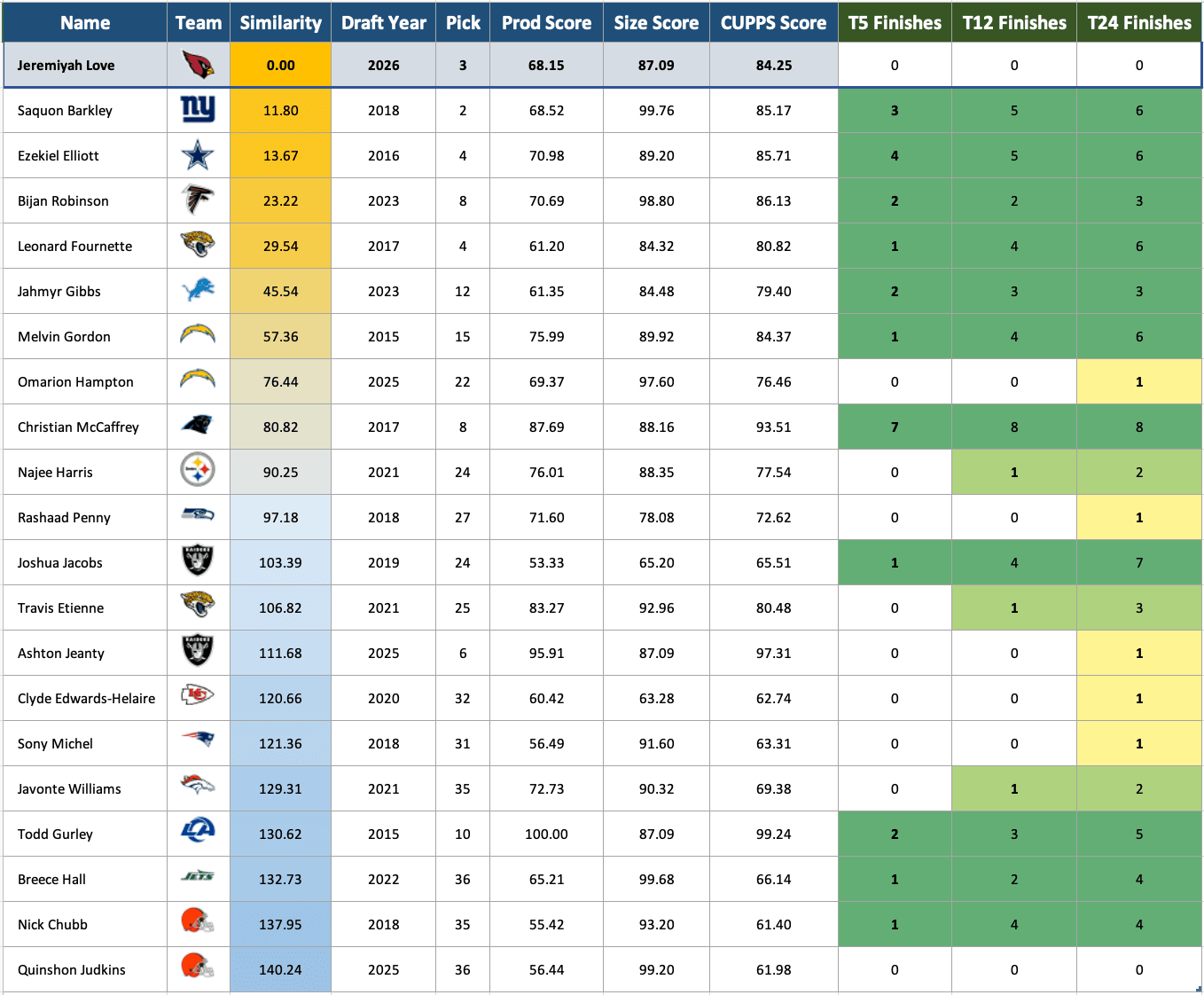
As you can see … lots of green on the above table. Of Love’s 20 closest comps, we see:
- 19/20 hit 1 + Top 24 FPPG finish
- 14/20 hit 1 + Top 12 FPPG finish
- 10/20 hit 1 + Top 5 FPPG finish (including all 6 of his closest comps!!)
And using these top 20 comps, we can generate an expected range of outcomes for Love’s rookie season based on what we saw from those 20 players on average:
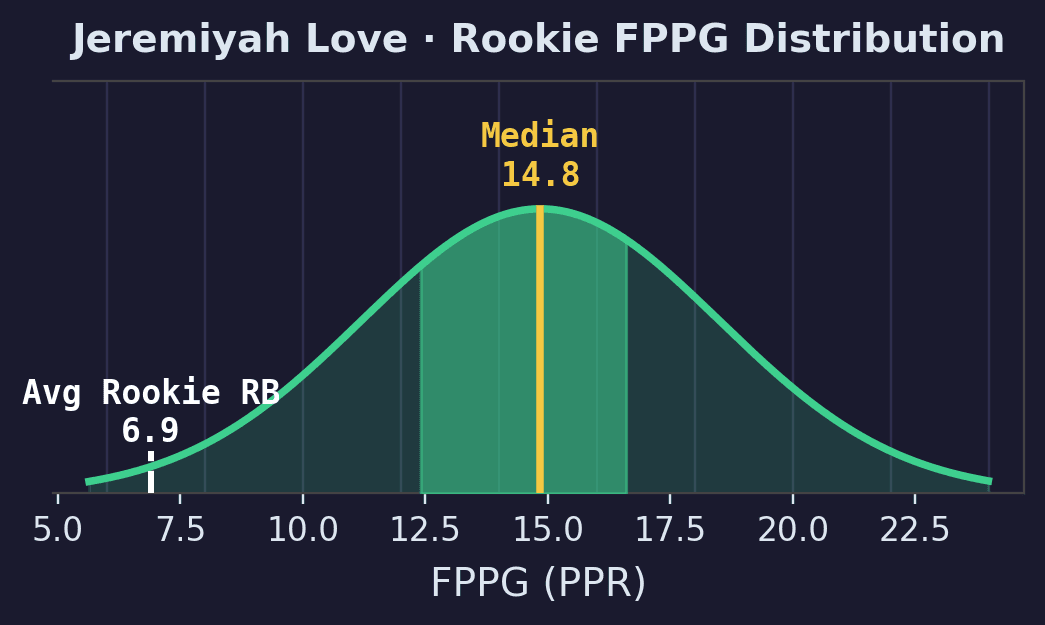
The bell curve above tells us that Love has a median rookie FPPG outcome right around 15 PPG, with upside over 20 PPG.
I’ve been creating individual videos on each of the 2026 rookies this offseason over on my YouTube channel, and you can check out that series here! These are just a couple of examples of the stuff I’ve been working on when it comes to leveraging data to create a competitive edge in fantasy football.
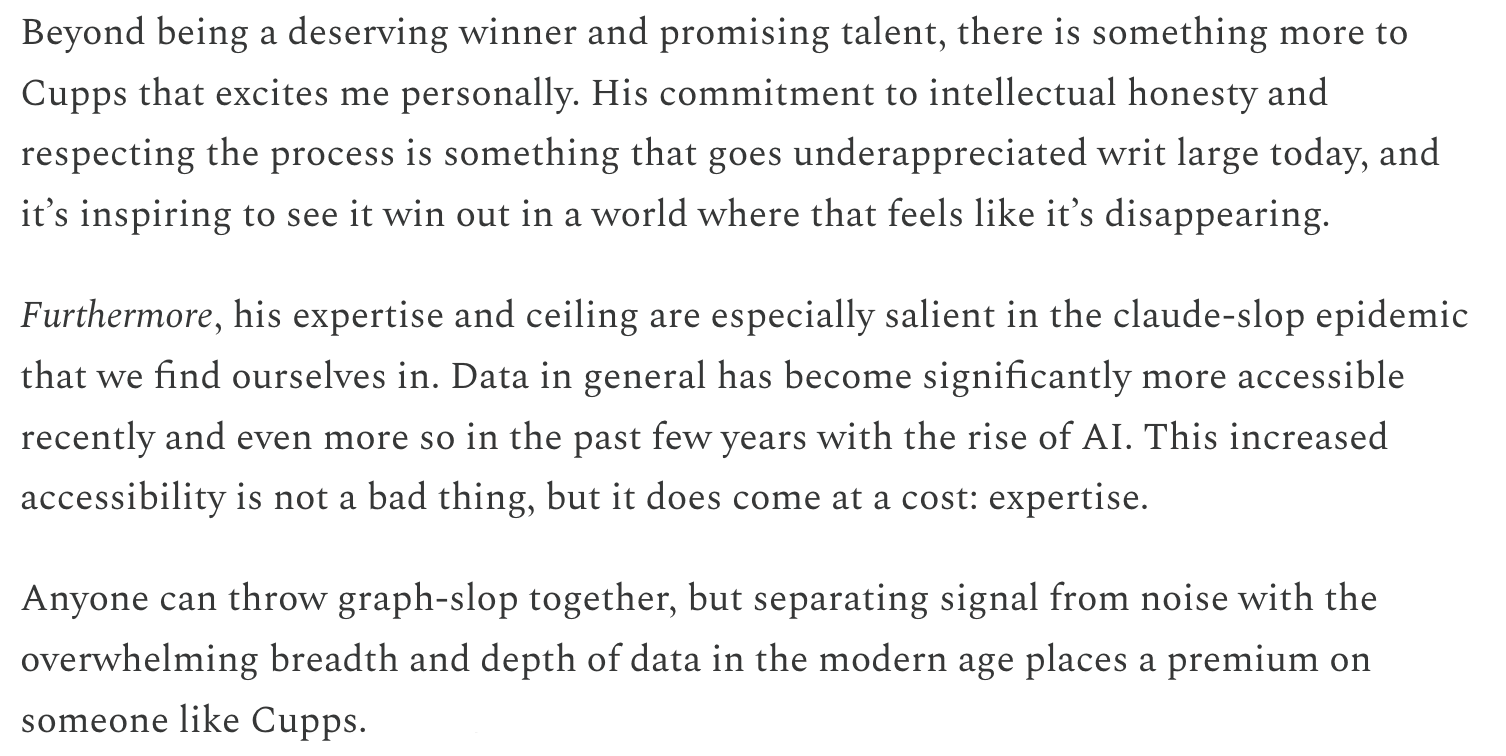
In closing … what kind of impact am I looking to make in the fantasy football space? I wanted to end this first edition of Cupps’ Cabinet with a quote from Rohin Mishra, a fan of the So You Think You Can Tout series, on his thoughts after the series finale—I think he summed it up better than I could have personally (and it means more coming from an objective third party):
If that sounds like the type of content you’d be interested in, stay along for the ride!
- Cupps

Join Our Newsletter
Trusted by 400,000+ fantasy football players. Get access to Fantasy Life's free award winning newsletter and tools, all in one step.
By registering or logging in, you agree to our Terms of Use and Privacy Policy.
Players Mentioned in this Article
- JeremiyahLoveRBARI

- Proj
- 209.3
Published Updated