Introduction To Receiver Score: How The Model Was Built & 4 Key 2026 Targets
Zain Dhanani introduces his Receiver Score metric, outlining how he built his model, what it communicates, and four standout players for 2026 based on the model.
Receiver Score is the metric I built to answer this question: How good is this pass catcher’s role? Roughly 82% of NFL routes never draw a target, which leaves an incredible amount of context out of the box score.
Receiver Score grades that missing 82%—it can describe the job a receiver held before the box score tells you how he finished it. It’s factored into my fantasy football rankings, and the rest of this is how it works, where it stops, and highlights a few players it likes in 2026.
The short version:
- Every route gets a grade, including the 82% that never draw a target.
- The final score combines QB fit, route mix, play design, red-zone work, alignment, defense, expected route volume and more.
- This can be applied to WRs, TEs or RBs—this article focuses on WRs.
Receiver Score, Explained for 2026
If a receiver runs 30 routes and earns 5 targets, we get 5 data points.
Those other 25 data points give us evidence about where he lined up, who was covering him, how many other players ran routes, whether he was in motion, the depth of his route, route type and much more. Ja'Marr Chase ran 669 routes in 2025 and was targeted on 195 of them, leaving 474 routes—71% of his season—that a stat sheet records as zero.
Those 82% of routes that never draw a target still carry a majority of the value my model assigns because they give us so much information about the role.
How the Score Works on Every Route
The model estimates:
- How likely is the receiver to draw the target?
- After factoring in the likelihood of the target, what is that target worth in terms of fantasy points (even if the target went elsewhere)?
Then, to simplify target probability, if three players run routes on a play, the average one begins with a higher implied chance of drawing the target than he would if all five eligible players went out—and that is before the model factors in talent.
From there it's about leverage, and the effects were bigger than I expected when I started measuring them:
- Motion at the snap: A receiver moving at the snap draws a target on 22% of his routes compared with 17% when he is standing still, and for WRs those routes produce 32% more actual fantasy points.
- Play-action: A dig off play-action is worth about 1.95x as much as a dig without it, while a vertical is worth 1.49x, a slant 1.41x, a flat 1.30x and an out 1.27x. Play-action-heavy schemes—and being on the field running routes on those plays—are fantasy cheat codes.
- Hash location: A receiver lined up on the boundary gets targeted on 20.2% of his routes compared to 15.3% on the wide side, a 33% change created without the receiver doing anything differently.
- Coverage: A slot receiver running away from a linebacker draws a target 24% more often than he does on the same route against a slot corner.
When you combine all of these factors and a few other small mechanical ones, that's how we get Receiver Score.
Why Receiver Score Is Built From Four Pieces
The score you see blends four separate grades, and knowing which one is carrying a player tells you what you're actually buying:
- Environment: how valuable the routes themselves are, given alignment, coverage, formation, situation and how the receiver's route tree fits the QB. It is also the stickiest component, repeating at a 0.89 correlation from one year to the next.
- Red-zone equity measures how much scoring opportunity comes with the job through expected targets inside the 10-yard line, keeping actual TD conversion from determining the grade and tending to create the biggest differences between players who otherwise look alike.
- Volume captures how much of that value there is, because a great job for 20 routes per game is worth less than the same job for 35.
- Talent: how good the player is in the context of their role in terms of earning separation on routes that are likely to be targeted
Air Yards and other target-based stats do an excellent job describing the throws that happened, although their coverage ends with the target and leaves the other 82% of routes unmeasured.
2026 Receiver Score Standouts
I picked four players I like from different parts of your draft because each one shows a different way the environment, red-zone, volume, and talent grades can come together. Their prices are included for context, using Underdog’s ADP.
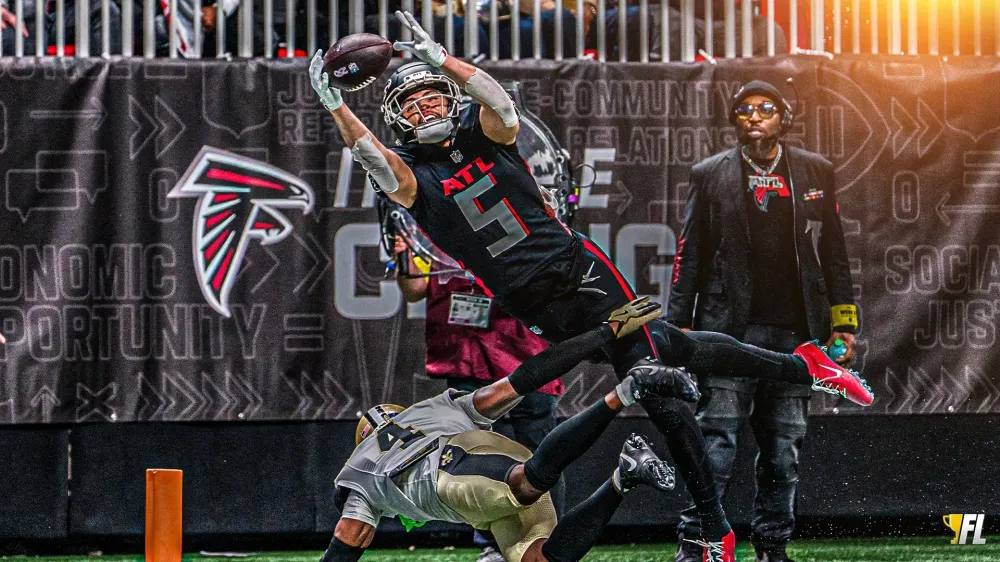
 Drake London | WR | ATL | Underdog ADP: 21.3
London entered the league with 74% of his routes out wide, but by 2025 he was running a third of them from the slot—one reason the big outside X label most people still carry no longer captures the role. His short, square route tree included 28% quick game (98th percentile among qualified receivers), including 19% hitches, and an out-route share in the 88th percentile.
The vertical work is still there, and his deep-route share has actually risen in three straight seasons, but he barely gets targeted on those routes. His target rate on vertical routes fell from 21.8% to 16.8%, so a lot of those deep routes are now clearing space for him to come back underneath, where the targets actually go.
Atlanta also made that role easier with bunch sets and motion, starting with the 43.8% of London's routes that came from bunch formations—good for the 86th percentile—on the team that used bunch at the second-highest rate in football. What bunch bought him was a free release: his press-coverage rate fell from 37.4% of routes to 25.3% when Atlanta bunched him, while his YPRR climbed from 1.98 to 2.51.
His motion usage rose too, with those routes drawing a target 32% of the time compared with 24% when he was standing still, and the combination of bunch formations and motion gives us a strong environment grade.
London also played that role at an elite level, with a per-route PFF grade that ranked in the top six of 137 qualified receivers alongside Puka Nacua, Jaxon Smith-Njigba and Amon-Ra St. Brown.
His per-game red-zone opportunity was essentially flat across three seasons, and his rate is really strong. Inside the 10, London drew a target on 39% of his routes compared with an 18% league rate, led Atlanta in inside-10 targets, and scored five of the team's nine inside-10 receiving TDs in the games he played.
Atlanta just hasn’t reached that part of the field that often during London’s tenure. The Falcons have ranked in the bottom third in inside-10 route volume in all three of London's seasons and in the bottom half in receiving TDs, limiting the number of chances London gets to use a genuinely strong red-zone role.
The biggest risks for 2026 start with the QB situation. Tua Tagovailoa's measured strength is digs and overs—a fit with London's middle-of-the-field role—while Michael Penix, who is rehabbing an ACL, grades poorly on depth but well on exactly the quick game London runs most. London's best per-route stretches have come with Penix—useful context on the fit that still leaves the 2026 outcome open.
There’s also always uncertainty when a new regime takes over. With Kevin Stefanski at the helm, the Cleveland offense ranked No. 24 in bunch usage, but used the ninth-tightest splits in football, which should make up for that. I also don’t anticipate much change from a red-zone or motion usage perspective.
 Zay Flowers | WR | BAL | Underdog ADP: 30.5
Flowers' size still gets him labeled as a slot receiver even though he ran 66% of his routes out wide last season, slightly more than the average starter. His 95% route share was both a career high and a 96th-percentile mark.
Motion is a much bigger part of Flowers' job than it is for the rest of Baltimore's WR room: he went in motion on 24.8% of his routes, the 95th percentile, compared with 6.4% for the Ravens' other WRs. Flowers accounted for 32% of all the motion routes Baltimore ran, and because a route in motion is worth about a third more in this model, Baltimore was directing that schematic value toward one player.
Flowers’ Receiver Score has risen each season because his environment continued to upgrade. Baltimore moved him away from the screen-and-hitch role he had as a rookie and gave him more out-breaking routes and work from 2-TE formations.
The menu stayed mostly the same in 2025, but his FP/route climbed from 0.428 to 0.480 because he converted it better. In-breakers drove the gain, with his digs going from 0.432 to 0.618 FP/route, and that matters when we get to the QB fit.
Flowers ranked around No. 31 of 137 qualified receivers in PFF grade per route, placing his own execution in the very good range, and his environment grade is even better. His high Receiver Score comes from how Baltimore deploys him and his very solid, but not elite, execution.
Lamar Jackson's measured strengths are verticals and digs, while Flowers' vertical share sits in the 22nd percentile, but his best work last season came on digs. It’s really good for projections when there’s a strong area of overlap like the dig component, even though it's not a perfect match on the vertical side.
The 2026 Declan Doyle offense is expected to maintain the motion cheat codes and expand with more play-action. The projected route tree and role are very strong for Zay Flowers as well.
 Christian Watson | WR | GB | Underdog ADP: 57.6
For 2026, I'm projecting a higher route share for Christian Watson (and Jayden Reed/Matthew Golden) because of what I’ve heard regarding fewer rotations at the receiver position to improve clarity and chemistry on the field (and the lack of depth behind them). The Packers vacated roughly 38% of their route load with Romeo Doubs' 484 routes and Dontayvion Wicks' 249 both gone, brought in almost nothing from outside, and Watson is the most established WR left in the room.
Watson ran 37% of his routes from the vertical family, the 92nd percentile, and 13% in the quick game, the 11th. Those rates gave him the most vertical route tree among the starter class, with about a third more deep work than an average starter and a third less of the easy catch-and-turn stuff. I wrote about being a deep threat as a bad thing in a previous article, but Watson fits into an exception because of the fit with Jordan Love.
Love threw deep at one of the five highest rates in football and also produced one of the five highest catchable rates on those throws—showcasing his ability to support Watson's vertical volume.
Additionally, motion accounts for an ordinary share of Watson's role and has produced fewer than his stationary routes in all four seasons. Play-action has been much more useful: Watson has ranked above the 80th percentile in play-action route rate for three straight years, and those routes produced 3.31 YPRR last season compared with 2.19 without.
His execution is why I'm comfortable with this projection, because Watson's PFF grade per route ranked in the top six among 137 qualified receivers alongside Puka Nacua and Jaxon Smith-Njigba.
Watson reached that grade with a catchable-target rate in the 49th percentile after two seasons of genuinely bad service, and he had only 1 drop on 56 targets. His unusual combination of a 96th-percentile aDOT and 98th-percentile YPRR gave him the kind of efficiency that rarely comes with a role this deep.
Love's measured per-route edge shows up most clearly on quick and outside-breaking routes, and Watson showed that same split last season with a target on 56% of his out routes and 4.47 YPRR. His vertical usage creates the space that lets those quick and outside-breaking routes produce underneath.
Watson has played 48 of a possible 68 games and has never completed a full season, while every efficiency number above rests on 10 games that began in Week 8. He also scored on 10.7% of his targets, the 95th percentile, with a league-median number of routes inside the 10.
Watson obviously outkicked his coverage in the TD efficiency category, but the uptick in routes and volume should far exceed that concern.
 Stefon Diggs | WR | WAS | Underdog ADP: 103.4
Diggs has the highest Receiver Score in this group based on 2025 and each of the four components graded very highly last season. He has the most balanced profile amongst this group.
Diggs now works primarily as a slot in-breaker, with 53% of his routes coming from the slot, quick game in the 78th percentile, and in-breakers in the 86th. That route tree is genuinely rare among older WRs—of the 20 qualified receivers who were 30 or older last season, only Adam Thielen ran a lower share of verticals, while Mike Evans, Davante Adams and DeAndre Hopkins were all above 31%.
Using league-average rates for each route type, Diggs' route mix is worth about 5% more targets and 4% more FP/route than a typical receiver's because he runs the routes QBs throw a ton, and I expect that to carry over to the Commanders with Jayden Daniels and David Blough calling the shots.
Only 14.6% of Diggs' routes came off play-action, the 12th percentile and dead last among the eight Patriots with at least 100 routes. That gave him about a third less help than a typical starter receives, so there’s some room for a better situation.
Defenses noticed and lined up 2.56 yards off Diggs compared with a league average of 3.01, the 13th-tightest cushion in football. He was pressed even more when he was lined up as an outside WR, so it seems like it was deliberate. Corners were leaning aggressively toward taking away the short game, and Diggs continued to produce against those tighter cushions.
The move to Washington is a pretty solid fit for Diggs. The Commanders vacated 49% of their route tree, second-most in the league, and the missing work matches Diggs' role almost perfectly: two-thirds of their slot routes left with Deebo Samuel and Zach Ertz, who combined for 883 slot-heavy routes. Diggs also barely overlaps with Terry McLaurin, who runs 86% of his routes out wide. While Blough will certainly mix things up and run 12 personnel, this will largely be what the roles are for the Commanders in 2026.
Jayden Daniels' biggest measured strength is the vertical game—more McLaurin's side of the route tree—while his above-league grade on quick routes gives him useful overlap with Diggs. Also, when measuring similar situations, when QBs get a receiver that executes at Diggs' level in a particular area of the field, it can elevate the QB’s efficiency in that area of the field.
Diggs' price has moved 23 picks in a week, so the discount that existed when I started writing this is already partially gone, but he’s still more valuable than his draft slot, which is reflected in my rankings. All of his scores grade higher than Terry McLaurin in my 2026 model, so I think there’s a decent chance he outproduces him; however, there’s inherent risk in that assumption—we don’t know if the route share he received last year was just due to coming off injury or a team trying to preserve the vet. I am assuming his route share ticks back up closer to a normal amount.
Coming Every Week During the 2026 Season
Once the season starts, I'll turn Receiver Score into a weekly article, and it will also help power my weekly rankings.
Each week I'll take what a receiver's job is worth, apply it to that week's game and model the probability of lineup-hitting and lineup-winning weeks.
When backtested, the model is much stronger than looking at previous fantasy PPG. It is also meaningfully better at identifying which of your startable players is about to swing hard in either direction, with both results holding in every season I tested.
This will be very powerful in-season because we will be able to measure the weight of personnel packages, injuries that shift roles, and much more.
Players Mentioned in this Article



Published Updated